

Deep tech built the AI. Deep tech can't get found by it.
What auditing 101 deep tech websites taught us about being wrong in public.
Somewhere in this dataset are the chips, the compute providers, and the infrastructure layers that the models behind ChatGPT, Claude, Perplexity and Gemini run on. So we asked those same systems a simple question: what do these companies do? For a third of the sample, the honest answer wasn't in the company's own words. It was assembled from press coverage, distributor listings, and archived articles, some of them years out of date.
We didn't set out looking for that story. We set out to test a different one, and got it wrong in a useful way.
We spent several weeks scoring deep tech websites. Not skimming them. Opening each one, reading what a buyer would read, checking what a crawler would find, hunting for the third-party record that exists about the company somewhere other than its own domain. A hundred and one companies across silicon, cloud AI, edge AI, robotics and quantum.
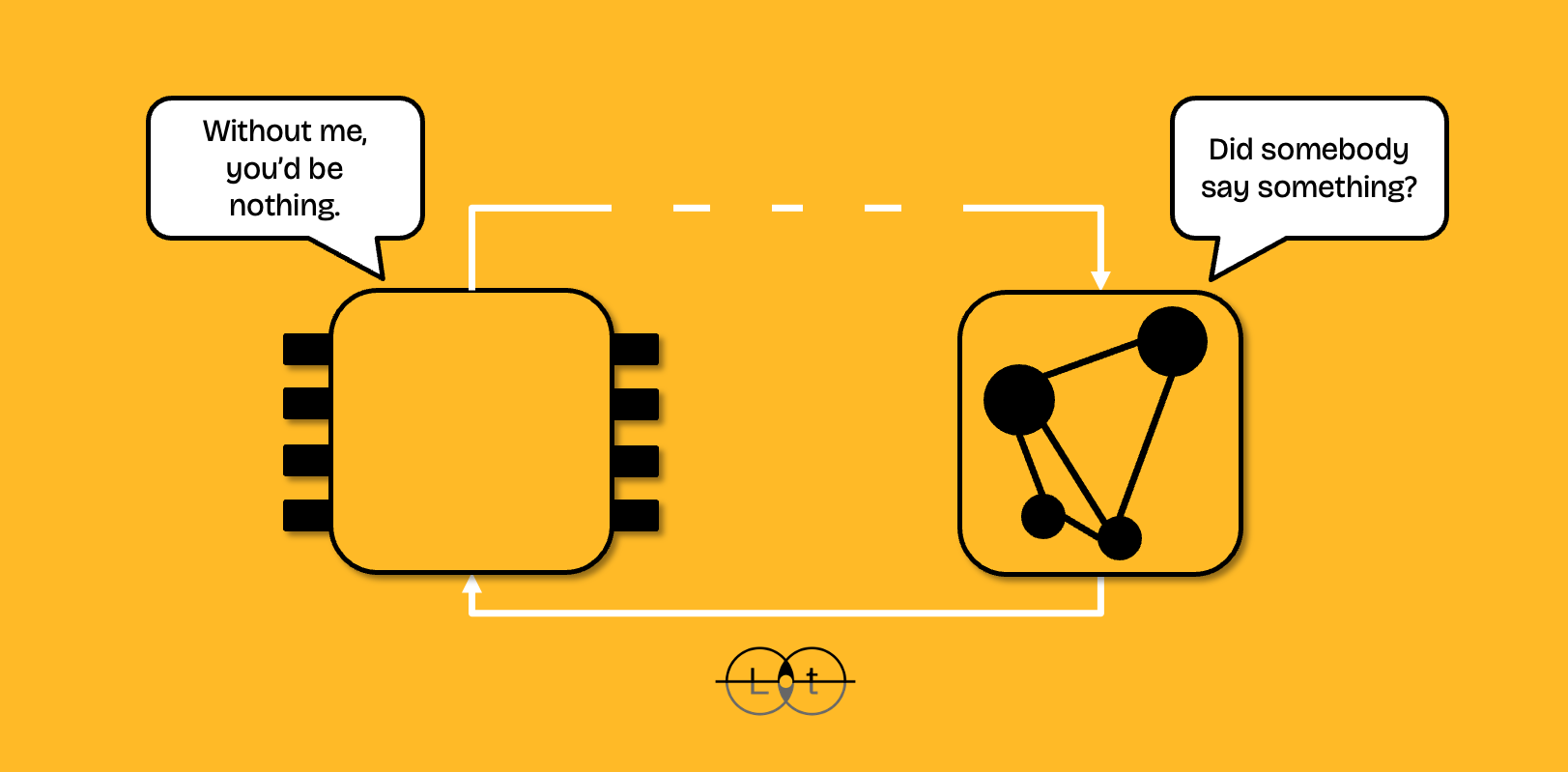
Deep tech is struggling to get recommended by the technology it helped build
We started with a hypothesis that felt obvious. Deep tech companies have real technical substance and bad websites, so they should score badly on traditional search and better on answer engines, because models can assemble an answer from the substance even when the site structure is poor.
The first segment we audited in full was silicon and semiconductor. Thirty-four companies, every one scored on both dimensions. The result was emphatic: answer engine scores ran twenty-four points ahead of search scores on average. Some individual gaps were forty points and more.
We had our thesis, with data behind it. So, we wrote the report around it.
Then we scored the other four segments
Cloud AI came back level. Edge AI, four points. Physical AI, minus three. Quantum, minus four.
The pattern we had built the report on did not exist. There was no sector-wide gap between search and answer engine performance. There was one segment with an enormous gap and four segments where the two scores sat more or less on top of each other, two of them tilting the other way entirely.
Silicon was not the illustration of a rule, but the exception, and we had generalised from it because it was the first segment we finished.
Which is a better finding than the one we lost
Once we stopped trying to make silicon representative, the actual explanation was straightforward, and more useful than the thing it replaced.
Semiconductor companies sit inside an unusually dense external record. Trade press covers them. Distributors list their parts with specifications. Standards bodies publish their membership. Academic papers cite their architectures. The listed ones have a ticker symbol that anchors their identity beyond any ambiguity. Ask a model what one of these companies does and it can assemble a confident, accurate answer without that company's own website contributing much at all.
That is why the segment scores forty-two on its own websites and sixty-six on answer engines. The ecosystem is carrying them.
We started calling it borrowed visibility, because it is not the same thing as being visible. These companies are being described accurately by systems their buyers use, on the strength of a record they neither wrote nor control. It looks like health on one score and failure on the other, and the honest diagnosis is neither.
It works until it doesn't. One company in the study has an external record that still confidently describes product lines it exited two years ago, because that is what the archived coverage says and nobody has restated the position clearly on the company's own domain. The record went stale and there was nothing on the site to correct it.
The finding that should worry people more
Quantum and physical AI run the gap in the opposite direction, and that is the more expensive problem, because it is invisible from a conventional SEO report.
These are not neglected websites. They have clean technical setups, good crawlability, active publishing schedules, genuine press coverage in the Financial Times, Bloomberg, IEEE Spectrum. On traditional search they score respectably. On answer engine readiness they fall behind, and the individual cases are stark. One Nasdaq-listed quantum company scores sixty-one on search and thirty-two on answer engines. Another, with a strong content and press engine, falls twenty-four points, because it presents a dual identity across two categories and a model cannot resolve what the company actually is.
The cause is not neglect. It is that the content is written to build a narrative rather than to state a fact. Deep tech marketing copy is often genuinely good writing, structured as an argument that unfolds. Answer engines do not read arguments. They extract claims. A page that never states a fact in one self-contained sentence gives them nothing to lift, no matter how well it is written.
These companies are doing the expensive work already. They are losing on the packaging layer, which is the cheapest layer to fix and the one nobody is checking, because their SEO dashboard says everything is fine.
Three other things we did not expect
Funding predicts nothing. One company in the sample has raised past a billion dollars across its rounds and its entire public website amounts to a company name and a careers link. Wikipedia currently carries a fuller description of what it does than its own homepage. Meanwhile a six-person pre-seed company in Malmö scores seventy-eight, ahead of most of its far better-funded peers, because someone there wrote a good llms.txt and a clear entity statement. That is a few hours of work, not a budget.
Having an llms.txt is not the same as having a useful one. Several companies technically have the file. At least one is auto-generated CMS output listing popup themes and slider taxonomies. The company's actual white papers and case studies never made it in. The file exists, the box is ticked, and it does nothing.
The most common gap is also the cheapest to close. Across a hundred and seventy-two individual findings, forty-three per cent were quick wins: one page, one tag, one file. Only nineteen per cent needed sustained content investment. Most of what is broken here could be shipped inside a week by one developer who knew what to fix.
What we would tell you to do with twenty minutes
Ask two questions, in order, against your own site.
● Does dedicated content exist for what you do, beyond a homepage and a press release archive? Real product pages, technical explainers, case studies. If no, that is the first problem, and it is a content problem measured in months.
● If yes, is that content structured so a model can extract it? An llms.txt file, direct-answer or FAQ formatting, structured data, one plain sentence stating what you are. If no, that is a packaging problem, and it is usually measured in weeks.
Then a third thing, which is not on that list because it is not a yes or no. Ask an answer engine what your company does, and read the reply as a buyer would. If the description that comes back is assembled entirely from press coverage and directory listings rather than your own words, you are being sold by other people, in their framing, with their emphasis, at whatever level of currency their archive happens to have.
That is borrowed visibility. The industry that built the machine still has to teach it who they are, one llms.txt, one FAQ, one plainly stated fact at a time. A third of the companies we audited haven't started.
The full Deep Tech Signal Report covers all 101 companies, five segment benchmarks, and the complete methodology. It is published as a web page rather than a gated PDF, which given the subject matter felt like the minimum we could do.
Read the report: lttps://www.latentconsulting.com/get-found-or-get-ignored
Book a Surfacing Call: https://outlook.office.com/book/SurfacingCall@latentconsulting.com