

Chiplets are +10 years old, but we’re struggling to describe them as anything other than building blocks
Where I started
Two years ago, I was tasked with explaining the technicalities of chiplets to a more commercial audience for Arm. The resulting marketing material remains on Arm's website and YouTube channel at the time of writing. It described the goal as an open chiplet marketplace and named the main obstacle: interfaces that weren't standardised yet.
On 17 November I went to the CW Connected Semiconductor SIG event in Cambridge, "To Chiplet or Not to Chiplet". I expected to hear how the commercial case had moved on. The speakers showed progress on standards, packaging and reference platforms. When the talk turned to who would buy open chiplets, and why, I heard much the same as two years ago, which is probably why the old content is still untouched.
The industry still describes the end goal with the same picture: chiplets as Lego bricks, picked from a catalogue and snapped together. One speaker put a fully open marketplace of that kind three to five years away, which is about one design cycle. If you want designers to pick your chiplet when that marketplace opens, you need to start positioning it now.
What has moved
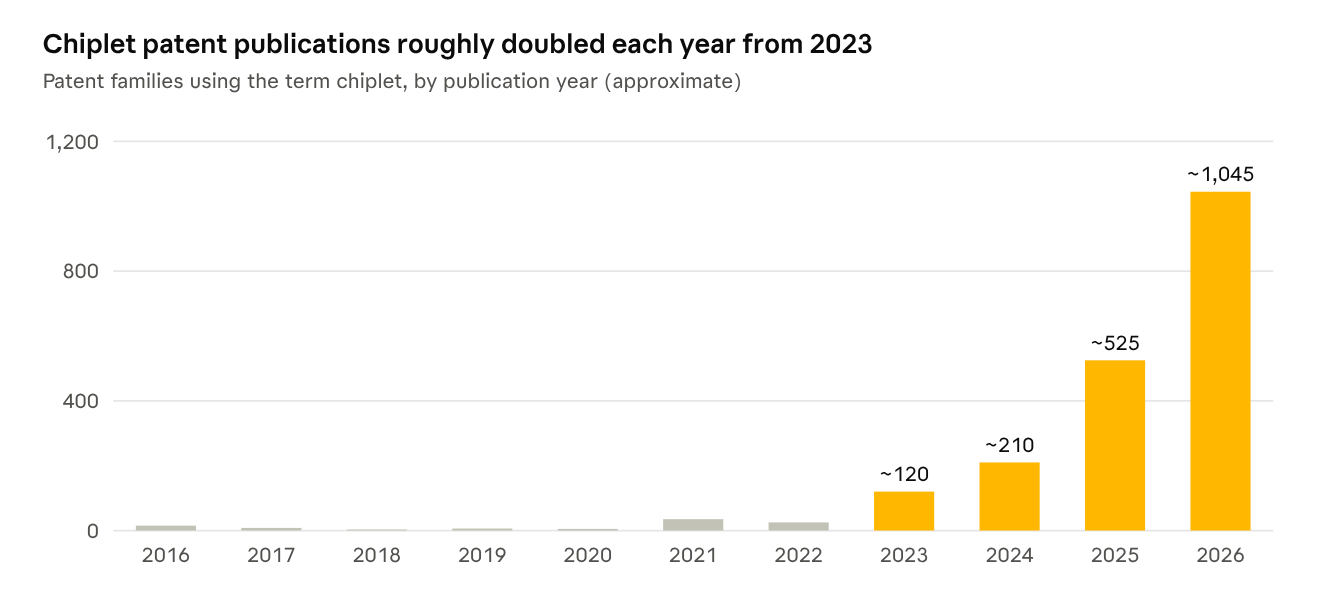
Marks & Clerk opened the event with a search for patent families that use the term chiplet. Publications stayed low from 2016 to 2022, then roughly doubled each year from 2023.
Chiplet momentum is gathering pace
The standards work has moved too. UCIe handles the die-to-die connection. Chiplet system architecture work has moved into the Open Compute Project as the Foundational Chiplet System Architecture (FCSA), which anyone can join, with a new release about every six months. Imec is building reference chiplet platforms for cars with partners across Europe.
What the speakers agreed on
Two speakers pointed to memory. One slide called HBM memory the first successful standards-based chiplet. Its reasons included a clean functional interface, a standard covering the whole functional contract, and DRAM already being something companies bought from outside. As the slide put it, HBM is "a new form factor; not a new commercial model".
A speaker from ST listed four barriers to an open chiplet market:
Standardising what chiplets do, which pushes them towards becoming commodities
Standardising interfaces above the physical layer
Verification, test and qualification, and deciding who is responsible for the integrated part
A business model that pays chiplet suppliers as well as the system companies
His slide also noted that UCIe and similar interfaces are generally available for nodes below 16nm. Much of ST's differentiated technology (analogue, power, MEMS, sensors) is made on other processes. Memory remains the one working example, he said, because its business model hasn't changed.
Stephanie Friederich of imec listed what still limits multi-vendor deployment. Commercial viability was one row, and it needs reuse benefits that justify integration costs. Her team also found that UCIe links from different vendors only connect when both sides use the same implementation.
Every speaker who touched on the commercial side described it as unsolved. I think each supplier has to work out its own offer and price, and who it sells to.
The missing track
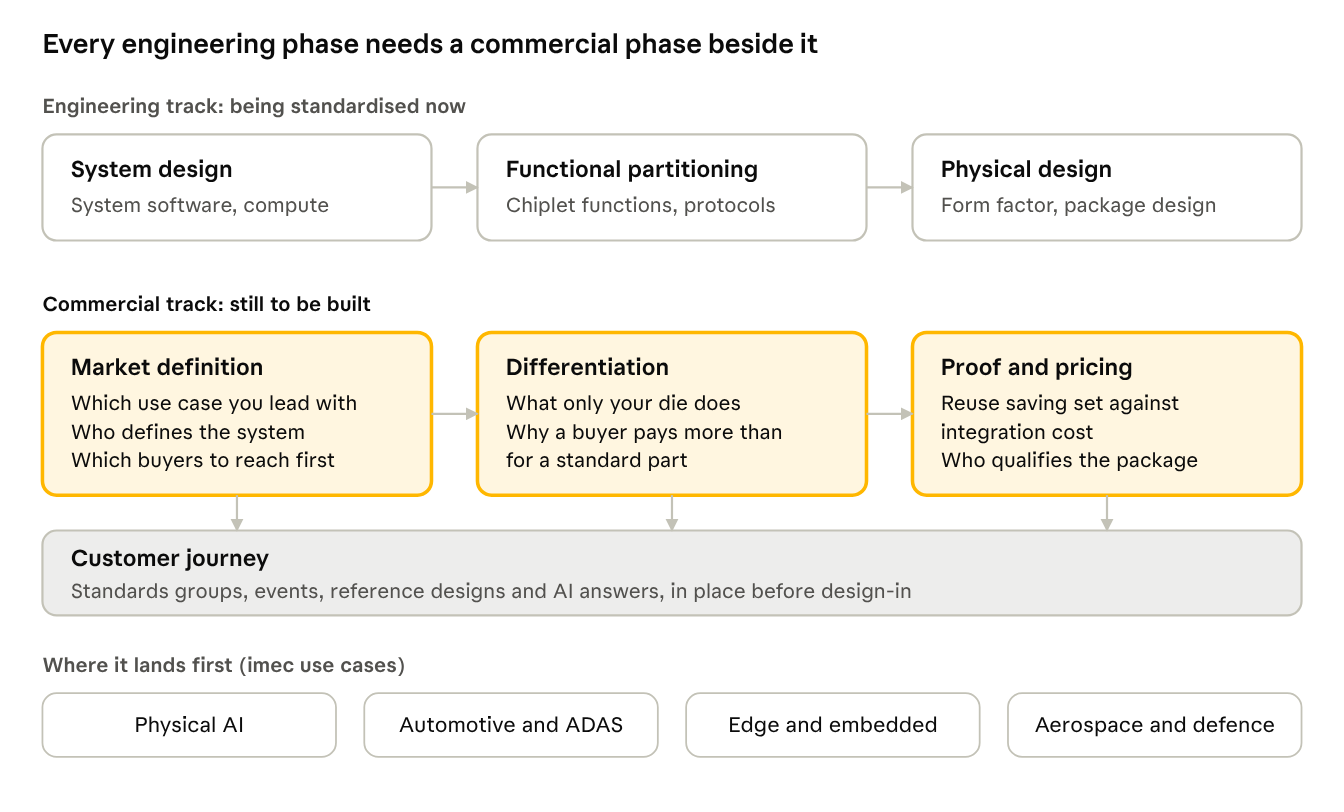
One speaker's slide on the scope of chiplet system architecture runs from system design, through functional partitioning, to physical design. I'd add a second track underneath it, moving at the same pace. For each engineering decision, you also have to decide which market the system serves, why a buyer should choose your chiplet, and how you'll prove the reuse saving.
The commercial track needs to be running in tandem
Buyers then need to hear those decisions through the touchpoints along the bottom, well before they choose what to design in.
Where it lands first
Imec started its automotive chiplet programme with carmakers. Since then, imec has found that physical AI, such as robots and other embodied systems, needs much the same things, and so do industrial, aerospace and security uses. Stephanie listed the shared requirements: higher temperatures, shock and vibration, and long service life. Most chiplet products so far were built for consumer devices or data centres, which run in gentler conditions.
If you supply chiplets, you can build one set of proof points on temperature, vibration and lifetime and take it to automotive, robotics, industrial and defence buyers. You still have to choose which of those buyers you talk to first.
Are you ready?
If the open marketplace arrives in three to five years, the products that use it are being specified now. These are the questions I'd want a chiplet supplier to answer at each phase.
Engineering phase |
Commercial question |
|---|---|
System design |
Which system will your chiplet sit in, who defines that system, and which use case do you lead with? |
Functional partitioning |
What does your chiplet do that a standard part can't, and how will a buyer see that when the interface is the same? |
Physical design |
Can you show the reuse saving against the integration cost, and who stands behind the qualified package? |
Customer journey |
Where will architects, engineers and buyers come across your story before they choose (standards groups, events, AI answers), and what tools will you give them to help them decide, such as reference designs, evaluation kits or a reuse cost calculator? |
You can run a quick check today. Ask ChatGPT or Claude which companies supply chiplets for ADAS or robotics. If your company isn't named, that's where I'd start.
At Latent, we help deep tech companies plan the commercial track and get it in front of buyers.
If you'd like a Signal Check on how well AI tools recommend your website, or want to talk through how to commercialise your chiplet offering, why not get in touch?
Dale Kaszycki is a co-founder of Latent and he's frustrated that we can build marvellous technology and still struggle to explain it.