

CUDA just got real on RISC-V. Here's how to capitalise on that limelight

In July 2025, Nvidia told the RISC-V Summit in China it would bring CUDA to RISC-V, so a RISC-V chip could act as the main processor in a CUDA-based AI system. It was a promise with no timeline. This month at Hot Chips 2026, the promise turned into a product: Nvidia published the technical bar a RISC-V platform has to clear (RVA23 compliance, vector extensions with predication, ACPI support via the newly ratified BRS spec, PCIe cache coherency), and SiFive demoed the BigSky SF-2U870, a rack server running RHEL 10 and CUDA on real workloads, available today. SiFive's CEO put it well: "RISC-V in the datacenter isn't a distant aspiration any more, it is happening right now." A year ago this was a slide. Now it's a spec sheet and a server you can order.
That's the news. What matters more for anyone working in or around RISC-V is what happens next, because a moment like this only comes along once or twice a year, and most of the ecosystem will let it pass by with a LinkedIn share and nothing else.
A rising tide raises all ships
This announcement doesn't just benefit Nvidia or SiFive. It's a credibility event for RISC-V as a category. Every company selling RISC-V IP, tooling, silicon, or services just got a stronger answer to the question every RISC-V vendor has been fielding for years: is this actually ready for serious compute, or is it still an embedded and edge story? Datacenter-class CUDA support, backed by a shipping server and a mainstream enterprise Linux distribution, is a genuinely different answer than the ecosystem had a year ago.
Search and AI answer engine interest in RISC-V as a category will tick up over the next few weeks, because interest in RISC-V-in-the-datacenter as a whole ticks up whenever a proof point like this lands, not just interest in Nvidia or SiFive specifically. Buyers who'd parked RISC-V as "watch this space" will go looking for more, and the companies who show up with something substantive when they look are the ones who benefit. The rising tide is real. Whether it lifts your ship in particular depends entirely on whether you're in the water when it comes through.
How to actually capitalise on it
Move in the window, not after it. The broad tech press covers a story like this for a few days, then moves on. There's then a two to four week window where people are still actively searching and asking AI tools about it, but almost nothing published so far actually explains the substance rather than repeating the announcement. That window is the opportunity. A same-week or same-fortnight piece that goes past the press release will outrank a more polished piece that shows up a month later, because both search and answer engines weight recency heavily on a live story.
Write for the next question, not the headline. The generic query "Nvidia CUDA RISC-V" is already crowded with rewrites of the same three facts. The gap is in what a technical buyer or engineer actually types next: does CUDA work on RISC-V yet, which RISC-V chips support CUDA, is RISC-V ready for AI datacenters, how does this compare to Arm for AI infrastructure, can I buy a RISC-V server that runs CUDA today. Build content that answers those directly, in plain sentences, and you're building for the question volume that's still coming rather than the one that's already spent.
Get named alongside the primary sources. RISC-V International, SiFive, and Red Hat are the accounts most likely to be treated as authoritative on this story by search and by AI answer engines. A piece that cites them accurately, links out properly, and adds something they didn't cover (a translation for a specific buyer audience, a caveat the coverage missed, a comparison the announcement didn't make) has a real shot at being picked up or referenced by the people already covering this space. That's worth more than any amount of keyword stuffing.
Make the honest caveat part of the pitch. BigSky ships in limited quantities. ACPI support has historically been patchy even on Arm after years of standardization, so the realistic read is narrower than "RISC-V datacenters have arrived": the technical blocker is gone and there's now a real product, not that this is mass-market yet. Naming that yourself, credibly, is what makes a piece trustworthy to an engineer and it's good practice for answer engines too, which tend to favor sources that show both sides rather than pure hype.
Turn one good piece into several formats while it's still current. A single well-researched explainer is the anchor. From it: a LinkedIn post making the sharpest single point (promise to production in a year is the strongest hook), a short technical breakdown of just the platform requirements for an engineering audience, and a follow-up comparison piece once competitors respond, because they will. One piece done properly beats three thin ones chasing the same keyword.
Connect it back to what you actually do. The highest-value version of this content isn't neutral commentary, it's commentary that lands on "here's what this means for you, and here's where we fit," whether that's IP, tooling, infrastructure, or services. That's the difference between a piece that gets read once and a piece that starts a conversation.
Structure it so both a person and a machine can use it. Clear headers that state a claim rather than a vague label, a direct answer near the top before the color and caveats, and the technical detail laid out plainly rather than buried in a paragraph. That's what a busy engineer scanning on their phone wants, and it's exactly what an AI answer engine is looking for when it picks a passage to cite.
The tide is rising for the whole ecosystem right now. The companies that publish something real on this in the next couple of weeks, rather than a share and a hot take, are the ones whose ships actually go up with it.
State of Marketing: RISC-V
The RISC-V ecosystem is moving fast. We audited 27 RISC-V International full members to map the marketing opportunity — and found consistent, actionable wins for companies ready to capitalise on their technical momentum.
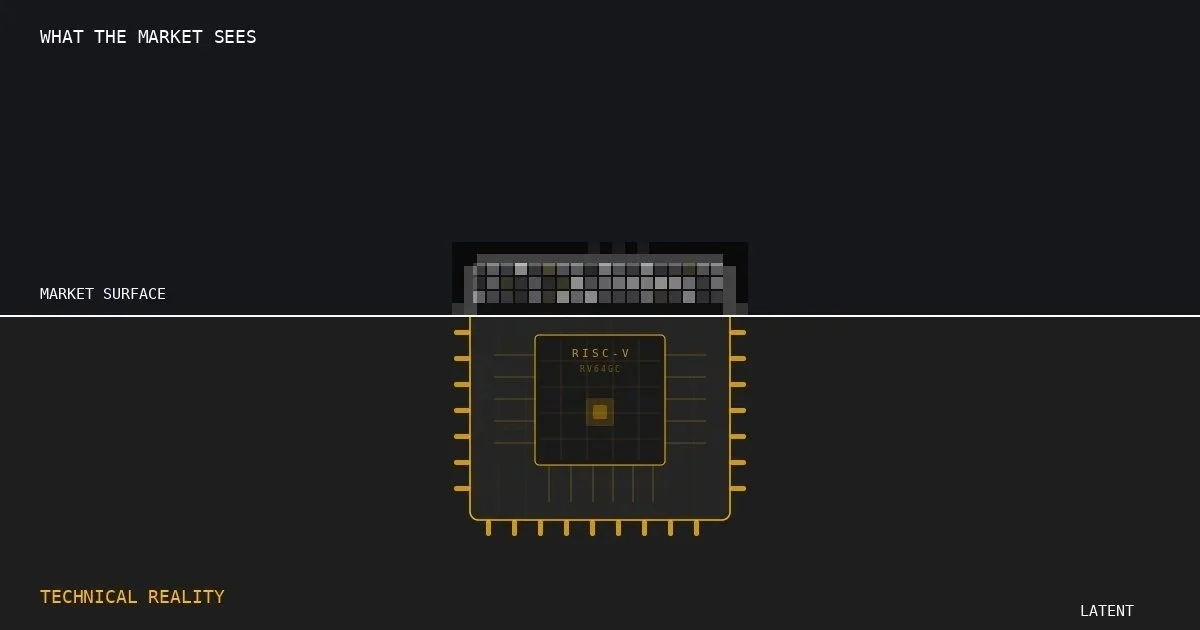
RISC-V chip shown below a market surface line — detailed circuit visible below, pixelated above, illustrating the RISC-V commercial visibility gap.
RISC-V is making great strides.
Here’s how to make sure the market knows it.
RISC-V Summit Europe just wrapped in Bologna. If you were there, you already felt the momentum. If you weren't, the signal is the same: this ecosystem is moving. NVIDIA ships over a billion RISC-V cores across its GPU products. Qualcomm has more than 650 million in Snapdragon. SiFive counts two billion devices powered by the ISA it helped create. The open standard once dismissed as a niche academic project is now embedded in the infrastructure of AI.
Speaking fresh from his opening keynote, RISC-V International CEO Andrea Gallo points to a confluence of factors making 2026 a genuine turning point: growing investment across the ecosystem, the ratification of the RISC-V Server Platform specification, and real RVA23 silicon that is shifting RISC-V from "inevitable" to "now."
But if now is the moment, the technical momentum isn't the issue. The issue is whether the commercial narrative is keeping pace with it.
We spent the last month auditing the marketing and content presence of every full member of RISC-V International — 27 companies across Premier and Strategic tiers. What we found is a sector with genuine technical credibility and a significant, largely untapped opportunity to convert that credibility into a commercial pipeline.
The range is wide. The highest score across the cohort was 62 out of 100, and a number of companies are genuinely punching above their weight — building strong content with lean teams and getting the technical story in front of the right audiences. What's encouraging is that the companies with the most headroom also have the most to gain, and in most cases the fixes don't require a single new hire.
It's worth saying that these aren't scores against some idealised benchmark. They reflect what's achievable with the resources most companies in this space are working with. The companies at the top of the range are doing this well under real constraints.
What's consistent across the cohort is a shared set of quick wins that show up regardless of company size, funding stage, or geography. The companies already acting on them are pulling ahead fast.
What the audit found
Five patterns stood out across almost every site.
1. The comparison conversation is up for grabs
Every buyer in this ecosystem — evaluating processor IP, development tools, or silicon infrastructure — will at some point search "RISC-V versus Arm" or compare two vendors directly. Those searches carry the highest commercial intent in the category. Right now, they mostly resort to third-party editorial: EE Times, AnandTech, Stack Overflow. The opportunity to own those conversations is wide open, and the companies that move first will define how the category is understood.
2. Proof points deserve more than a press release
Shipped volumes, funded amounts, customer wins — these numbers are the commercial backbone of any deep tech company's credibility. The quick win here is giving them a permanent home. A dedicated page with context, citations, and a narrative holds onto search authority indefinitely rather than fading after a few weeks. It's consistently one of the highest-return moves we identified.
3. The hub page is often missing
For many companies in the cohort, the content is already there — it's just distributed across product sub-pages and developer portals on separate subdomains. Consolidating it around a single hub page is one of the fastest ways to see outsized returns from work that's already been done.
4. Partnerships get announced. They rarely get capitalised
A hyperscaler co-marketing deal or a Tier 1 OEM partnership is a landmark moment — and it creates a keyword cluster that could drive qualified traffic for years. The companies getting the most from this treat each partnership as a content asset to keep building on. A handful of members have cracked this, and the traffic differential versus peers is significant.
5. Developer documentation is a double-edged asset
Technical documentation is often the most authoritative content a company produces — and in this ecosystem it frequently lives on a separate subdomain. Every Stack Overflow citation, every GitHub reference, every developer forum link builds authority that doesn't feed back to the commercial site. The fix isn't to merge documentation into the main site — it's to create deliberate bridges between the two.
Why the next 18 months matter
RISC-V has proven its place. What happens now is about visibility and commercial translation — which companies can make their proposition legible to enterprise procurement teams, to non-specialist investors, to the partner ecosystem that determines distribution at scale.
The companies in this ecosystem that build their content and credibility infrastructure now will be the ones that define how the category is understood — by buyers, by investors, and by the press. The technical story is already there. The marketing resource to carry it is established.
That's the RISC-V marketing opportunity. It's measurable, it's consistent across the cohort, and for the companies already doing well on the technical side, it's the natural next move.
Latent works with deep tech companies to build the marketing credibility that makes complex technical propositions commercially legible. Curious where your company landed in the audit? A few scored higher than they expected — and the gaps that did show up were often simpler to address than assumed. If you'd like to compare notes or discuss how to close the gap, get in touch. We'd love to talk.