

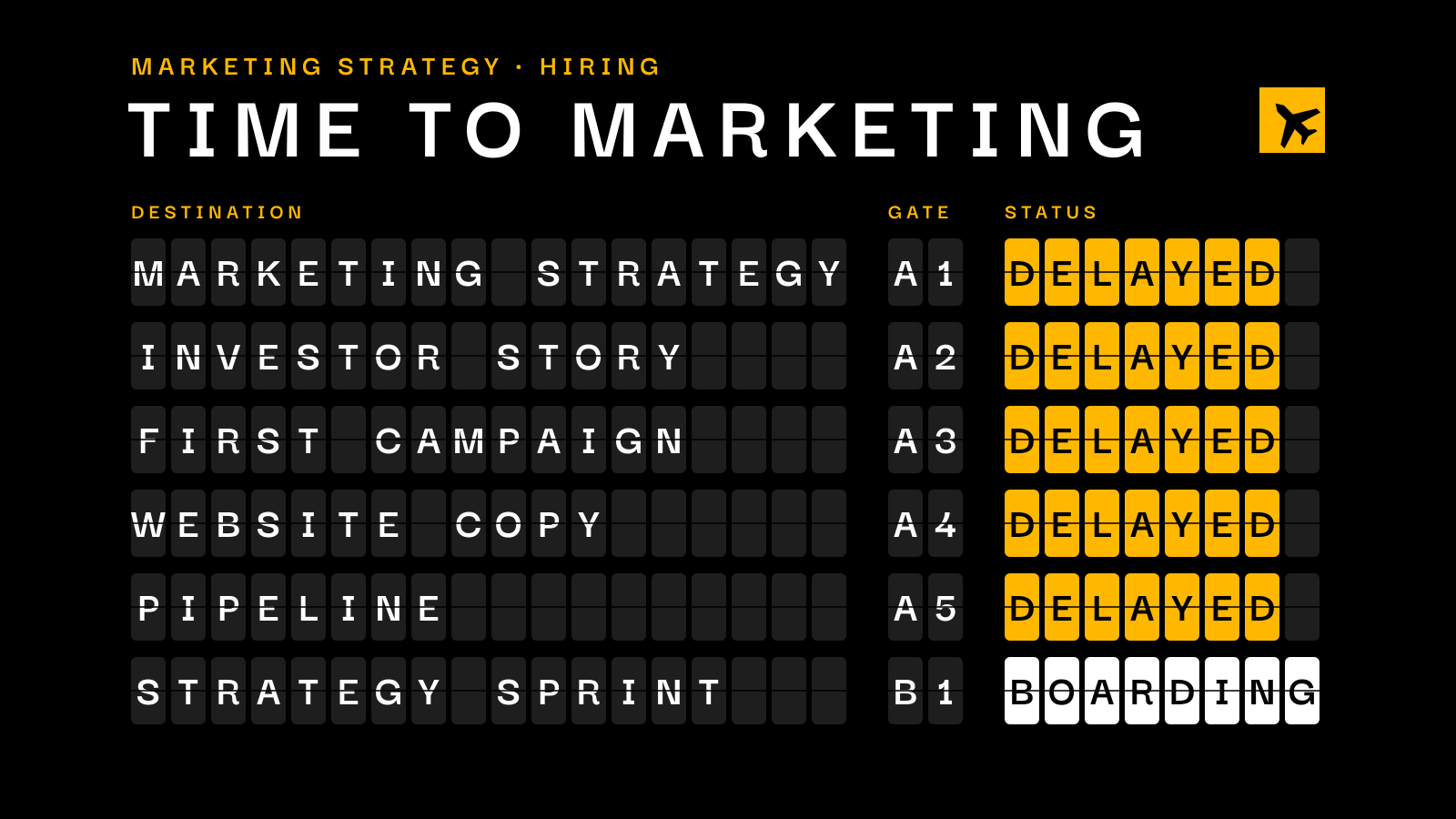
When marketing starts late, everything behind it runs late too.
You've just raised. The board wants pipeline, the investors want a story they can repeat, and nobody on your team is sure what the first marketing brief should say. You know you need to start marketing, but right now it falls to sales, engineering and you, and nobody owns it.
Most companies answer that by hiring, and that is where the time goes. I call the wait between deciding to invest in marketing and that investment producing anything Time to Marketing (TTM). The idea behind it comes from shift left. If you find a problem earlier in the cycle, you solve it cheaper, faster and with less friction. In software testing, it means you catch bugs before they're woven into production code. The same principle applies to your marketing.
Your board probably doesn't track TTM. It tracks time to revenue, product time to market, and customer acquisition cost once a pipeline exists. The wait between "we need to get marketing moving" and marketing actually moving gets filed as admin. You can manage it, and most companies never do.
Here's how it usually goes. The round closes, and the board agrees marketing needs to react. Someone writes a brief, or more often a job description that has to double as one, because nobody has agreed what marketing is for yet. A search opens, and three to six months later a candidate starts. In month one they listen. In month two they form a view. In month three, they start to act on it. By then it's seven to eight months since the board said yes, and marketing has produced very little.
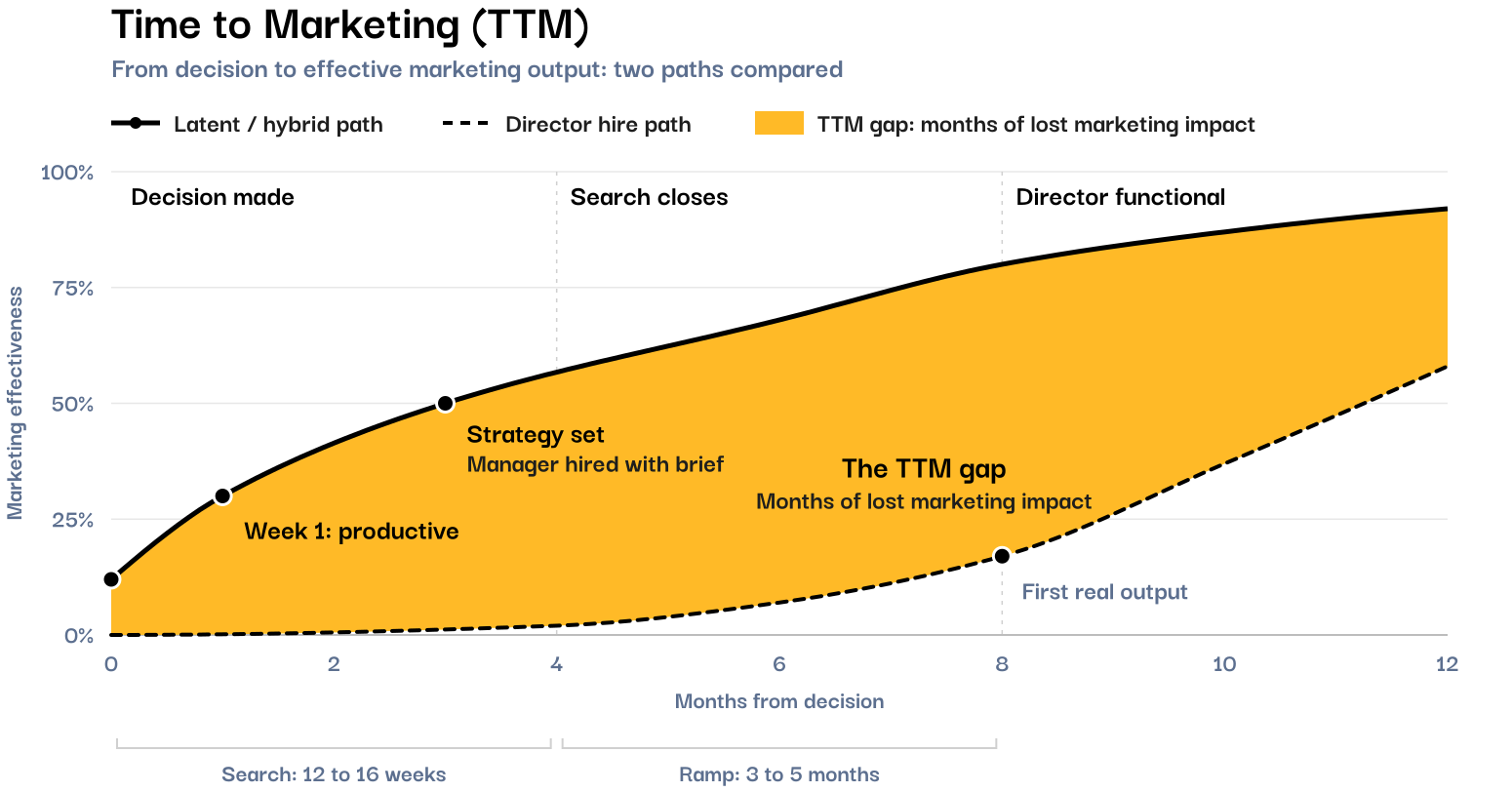
Chart showing a hybrid strategy-first path reaching marketing impact months before a Director hire path, with the gap shaded amber.
The gap between those two curves costs more than time, because it compounds. In deep tech, the commercial windows that matter keep moving while you interview candidates: the next funding round, the OEM evaluation, the media relationship that shapes how people write about your category. Your investors are already asking what the last round bought. If you're visible when a procurement conversation opens, you start ahead of a competitor who isn't. TTM tells you how much of each window you're working with and how much you're sitting out.
I've seen this from both sides. Before Latent, I interviewed for Director roles. In a couple of cases I reached the final round before stepping back. The companies were interesting, but I could see the brief wasn't there. The function didn't exist yet and nobody had agreed the priorities, or the long term need for a senior hire. I could picture the conversation nine months in, and it wasn't a comfortable one. That told me Latent had a place in the market. Deep tech is short of marketing expertise, and it also has a sequencing problem that puts capable people into roles they're set up to struggle in.
There is a different order of operations. Start with strategy. Decide what marketing needs to do for you right now: build commercial credibility before your next funding milestone, give the board pipeline attribution it can see, or put in the infrastructure that makes measurement possible. Settle that before you write a job description. Then hire at the level the work needs. For most companies that have just raised, that is a strong Head of or Manager, not a Director, with a clear mandate and a measurement framework in place before they start.
That cuts TTM a lot. People who have solved this problem before can put a strategy in place in weeks, not months. The person you hire joins a function that already exists, with a tested brief and agreed outcomes. In week one they're productive, by month three you have a campaign live, and by month six you have data and a pipeline you can show your board.
Shift left works here for the same reason it works in testing: the earlier you answer the strategy question, the cheaper and faster everything after it gets. When a Director hire fails nine months in, the cause is sequencing. The company deferred the strategy question to the hire, and the hire paid for it.
Most companies treat Time to Marketing as fixed. You can set it, and the first decision is whether to write the strategy before you write the job description. If you've just raised and don't know where to start, start there.
Dale Kaszycki is a Co-Founder and Director at Latent