

How do you position a technology that takes value from your own partners?
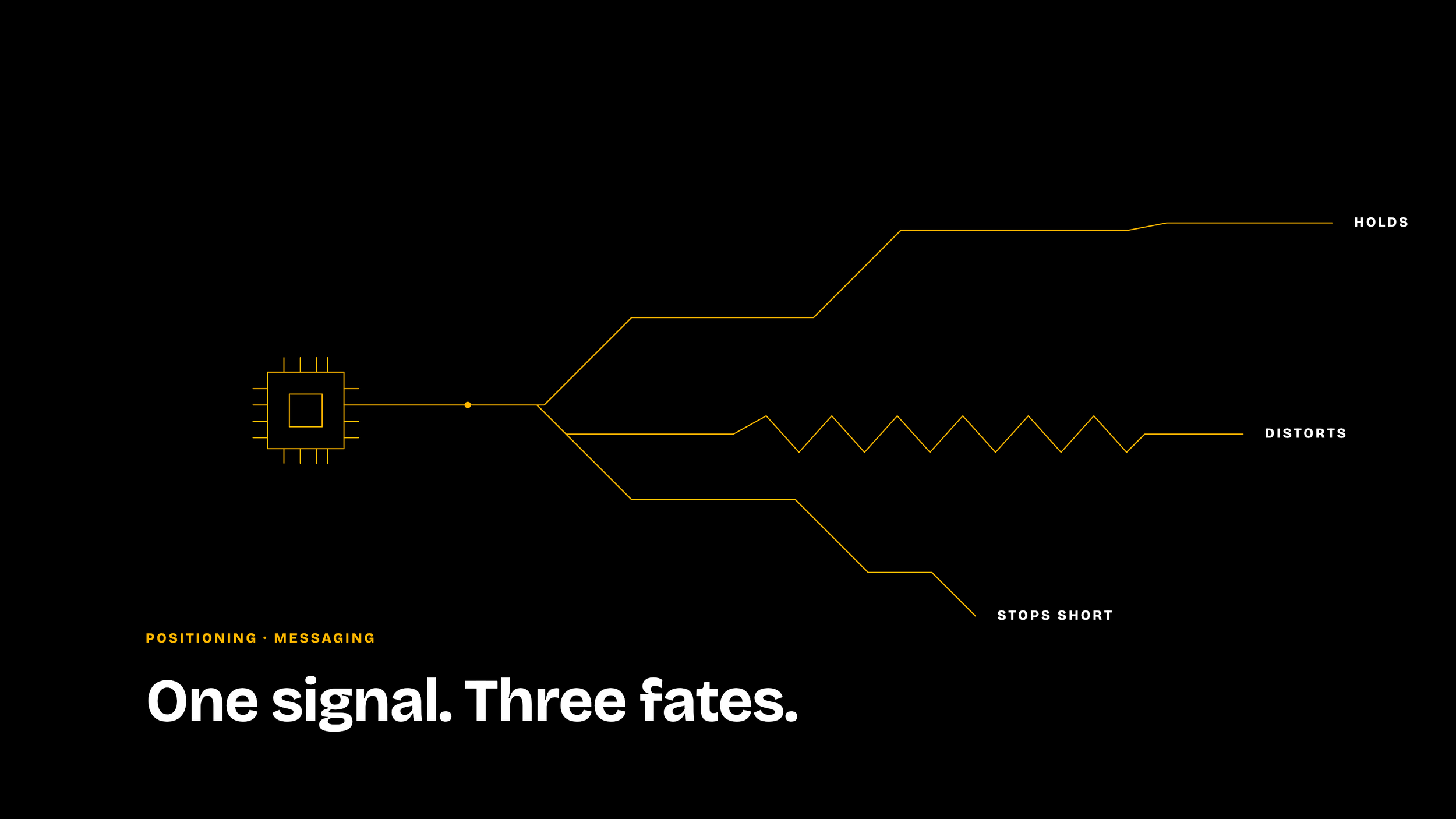
Diagram: a signal from a chip splits into three paths labelled Holds, Distorts and Stops Short.
There's a version of this problem that sounds like a good problem to have. You've done the work. You understand where the value actually sits in the supply chain. Your client's technology shifts the economics: it compresses time to market, reduces integration overhead, and moves a capability that used to live downstream to a point higher up the chain. The story resonates, and the data backs it up. Yet when you say it out loud, the room goes quiet in the wrong way.
We ran into this when marketing compute subsystems. The technology did exactly what it claimed: reorganising how compute was delivered across a complex hardware architecture in a way that changed what was possible. The problem was that telling that story clearly also meant telling a story about who was losing something, possibly implying that some of our efforts rendered them redundant, when we were sparing them from the mundane tasks and freeing them to add value elsewhere. The OEMs we needed to bring with us were the same people who felt, not incorrectly, that the value we were articulating was coming at their expense.
This isn't a communications failure. It's a structural tension that no amount of redrafting resolves on its own. When a technology shifts value from one part of a supply chain to another, the people at the losing end of that shift will feel it in the positioning before they feel it in their contracts. Positioning travels through whitepapers, analyst briefings, and conference keynotes. They often hear your story before you've had a chance to frame it for them directly.
When Arm began moving into AI silicon in a way that put them in direct competition with companies that had built their businesses on Arm's architecture, the technical argument was sound, plus the opportunity and capability were there. But the message that reached their ecosystem said, essentially: the partner relationship you've been building for years is now also a competitive one. The market heard it. Partners heard it. And there was a risk of them hedging.
This is what makes value shift positioning difficult. The story isn't wrong. The same story lands differently depending on who's reading it. In deep tech, where ecosystems are tightly interconnected, and relationships run long, the people you're pitching to and the people you need to keep onside are often the same people.
The answer isn't to soften the claim. Diluting the positioning to avoid the friction usually means losing the clarity that made it worth saying in the first place. The answer is to separate the messages and build a version for each seat at the table.
What you say to an investor about a compute subsystem is not what you say to an OEM partner. For the investor, the story is about market structure: where value is concentrating, what the defensible position looks like, why now. For the OEM, the story has to be about their outcome specifically. Not what the technology does in the abstract, but what it unlocks for the engineer in their organisation who is currently spending six months on integration work they'd rather not be doing. Shorter delivery cycles. Less overhead carrying hardware complexity they didn't choose. More time and budget directed toward the part of the product only they can build.
Same technology. Same underlying truth about where the value sits. But completely different framing.
We've had to rebuild positioning mid-engagement because we went too far in the other direction: we went too hard on the structural argument in a room that needed the operational one first. The tell is usually resistance that doesn't quite match the logic. If smart people are pushing back on a claim that's demonstrably true, the problem isn't usually the claim. It's that the frame you've built around it is threatening something they're not ready to give up.
When that happens, you pull it apart. You go back to the individual. You find the specific outcome they care about and start there. You earn the structural argument by demonstrating you understand their situation before you tell them how it's changing.
The hardest version of this is when the value shift is real, significant, and ultimately unavoidable, and your client needs to lead that conversation rather than respond to it. In those cases, positioning isn't just a marketing question. It's about managing the sequence in which different parts of an ecosystem understand what's happening and why. Get that sequence wrong and you create resistance that slows the adoption of something that would have helped the people resisting it.
Get it right and you can bring the supply chain with you, even when the supply chain is, in some sense, the thing that's changing.
I'm Dale, co-founder and director at Latent. Let me know if you'd like to have a chat about your positioning.