
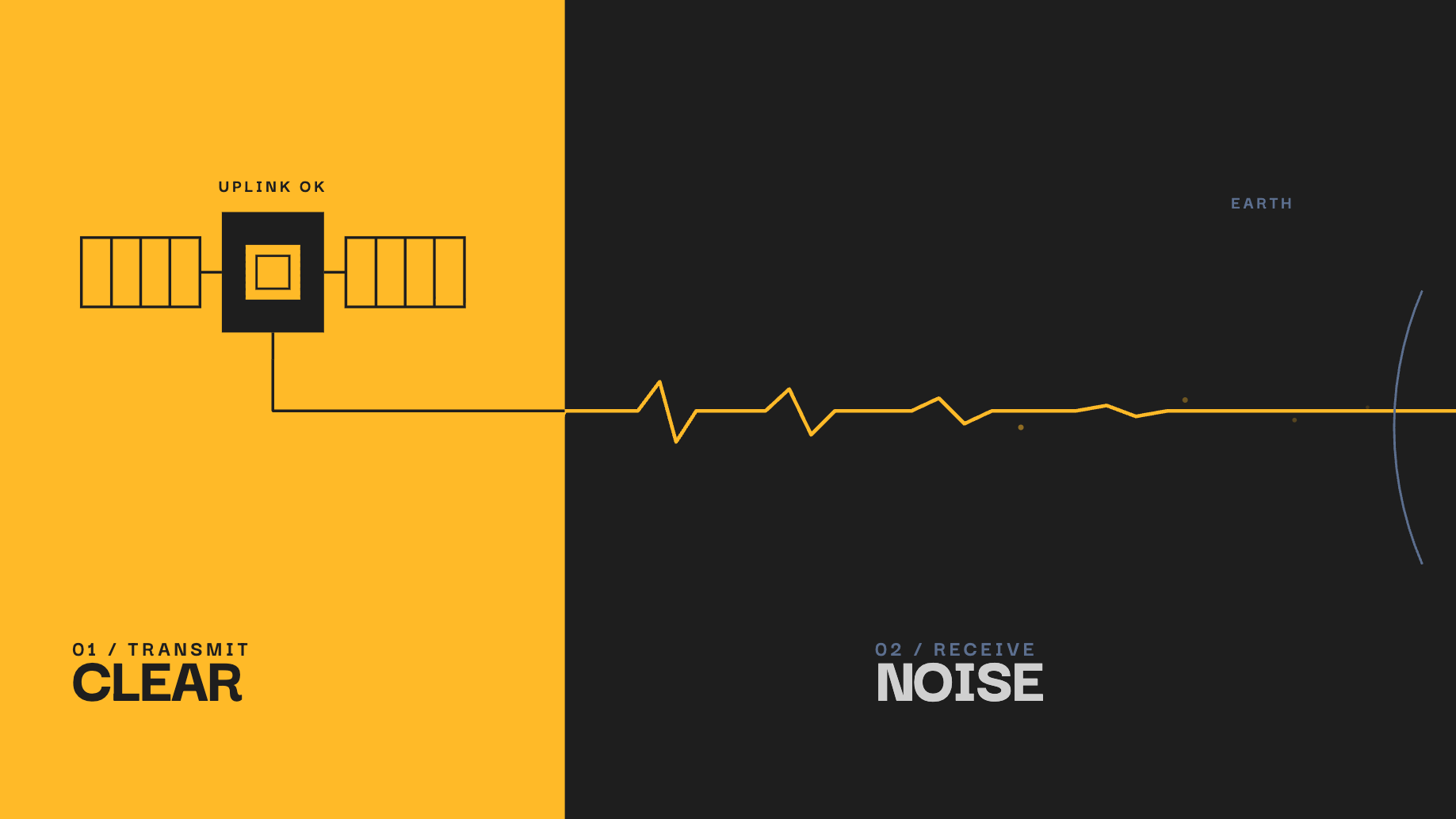
Ready for space, not ready to be understood
I spent a day at a deep tech summit recently talking to founders across the funding spectrum, from freshly minted Series A companies to businesses that have been shipping for over a decade. Each was at a different stage, in different markets, with different technologies. But one problem kept surfacing, almost word for word, across five separate conversations.
None of them could tell me what their company was worth.
They could all tell me what it was, in precise, fluent, technically correct detail. But when I asked the simple question every investor and every customer is really asking, "what does it do for me," the answer kept coming back as a spec sheet.
Here is the clearest example, with the company kept anonymous because the founder was incredibly smart, generous with their time, and building something important. Which is rather the point.
We got talking. I asked what the company did. Without a word, he reached into his pocket, produced some hardware, and walked me through its technical specifications. I asked again: what does it do? He answered by telling me, in detail, what the componentry does. Not what it changes. Not what it protects. Not what it is worth to the person holding it.
That evening I went to the website. It added a second layer of fog. Clean enough, but it read like a parts catalogue, somewhere between a Screwfix listing and an Amazon product page. Nothing on it told me what the thing was for.
So I dug. And here is what that company actually has. The product is an entropy source: the component that generates the raw randomness sitting underneath encryption. That still sounds dry until you follow the thread. Every encryption key depends on randomness. If the randomness is predictable, the key is guessable, and it does not matter how advanced the algorithm sitting on top of it is. This is the quiet foundation that the whole of digital security rests on. Most systems today produce that randomness in software, using deterministic maths to imitate chance. It holds until someone with enough compute and enough motivation decides to work backwards.
Asking a piece of deterministic software to produce true unpredictability is a bit like asking a calculator to write poetry. It can approximate the shape. It cannot do the thing.
This company's board draws its randomness from physics itself, which is about as close to truly unpredictable as it gets.
Now add the timing. Adversaries are already recording and storing encrypted data they cannot yet read. The bet is simple: capture it now, decrypt it later, once quantum machines can break today's encryption. It is called harvest now, decrypt later, and the harvesting is happening today while the decryption waits in the near future. Warehouses of hoarded data are sitting quietly, waiting for the day the locks stop working. Post-quantum cryptography regulation is arriving to force the migration, with 2030 already marked on the calendar as a line in the sand.
So this is the foundational security layer for the post-quantum age, built on elemental physics, aimed squarely at nation-state adversaries and the kind of threats that keep governments and enterprises awake. And the proof was all there. Patented. Tested in low Earth orbit and proven in zero gravity, which is a decent hint it can cope inside a data centre. Trusted by four major OEMs. Cheap. A clear path from a USB key you can hold in your hand up to rack-scale deployment. A regulatory tailwind, and an investor story that stood up. All of it real, none of it landing, while I was being handed a board and a list of specs.
The distance between what that company is and how it was described was enormous. And it was not a one-off. It was the fifth version of the same conversation I had that day.
This bit is key- This is not a criticism of founders. It is the norm among brilliant technical people, and there is a good reason for it. When you have spent years inside a technology, you understand it at the level of how it works. The value it creates for someone standing outside it is a different language, and fluency in one does not hand you fluency in the other. The founder was not failing to communicate. They were communicating the wrong layer, because the technical layer is the one they’ve lived through 50-hour weeks for years.
The cost of that gap is heavy and mostly invisible. In a room full of people who cannot easily tell a real breakthrough from a forgettable one, the companies that win attention are not the best ones. They are the ones that are easiest to understand. Investors nod politely and move on. Customers file it under "not sure I need that." Partners never make the call. The technology does not fail in the lab. It fails to get out of it.
This is the problem we built Latent to solve, and it is why we describe ourselves as the translation layer. Deep tech companies are often technically extraordinary and commercially invisible at the same time, and the distance between those two states is not more engineering. It is positioning, narrative, and the discipline of leading with value instead of specification.
The work has a natural order to it. First you make the technology legible: you find the one sentence that tells a stranger why it matters, before anyone else defines the company for them. That is what turns a board in a pocket into "the foundational security layer for the post-quantum world." Then you build the credibility around it, the proof and the presence that make serious buyers take it seriously. Then, and only then, you turn that into pipeline and revenue. Lab, to market, to commercial traction. Most deep tech companies are stuck at that first step, and most do not realise it is where they are stuck.
We spent years at Arm doing exactly this for compute categories that people could not yet explain. AI silicon, compute subsystems, inference at the edge. None of them sold themselves. The job was turning opaque propositions into language that investors, OEMs and enterprise buyers acted on. The companies I met at that summit need the same thing- Some of them get it, and we’re meeting again this week.
The technology in that room was ready for space. It simply was not ready to be understood. And in this market, being understood is the part that decides whether you make it to revenue.
If you are building something remarkable and watching people not quite get it, that gap is fixable, and it is usually the highest-return work you are not yet doing. The best technology does not always win. The clearest usually does.
I’m Dale, I’m a Co-Founder here at Latent, and I love these kinds of conversations.