

How to find the story before the technology is ready

The conversations I find most interesting right now are with companies that are somewhere in the middle. They’re not early-stage, where the story is mostly about potential and team and why the problem matters. Not mature, where the technology speaks for itself and marketing is largely execution. The middle — where the technology works, the use cases are real, but the market doesn't yet have a way to evaluate it.
The middle ground
Quantum computing is the clearest current example. We're speaking to companies navigating the shift from trapped-ion qubits in university labs to commercially scalable quantum processing units that can sit alongside traditional server racks in a 19-inch chassis. The engineering is sound. The commercial opportunity is vast. And yet the dominant public narrative around quantum is still somewhere between science fiction and perpetual ten-years-away scepticism, which means that every conversation with a potential customer or investor starts from a deficit of credibility rather than a foundation of it.
Quantum’s credibility gap
The instinct, when you're in this position, is to reach for scale. To try to collapse the credibility gap by making the biggest possible claim about what the technology will eventually be able to do. I get the logic. It's also usually the wrong move.
The problem with marketing ahead of the technology's maturity is that the audience you most need to convince — the CTOs, the infrastructure engineers, the people who will actually integrate this into a production environment — are precisely the people who will see through over-claiming first. They've heard the roadmap pitch before. They've been burned by it. And once you've lost that audience, getting them back is significantly harder than earning them in the first place.
Why over-claiming backfires
The other failure mode is the opposite one: waiting. Holding back the story until the technology is fully optimised, fully proven, fully ready for the case study. The problem is that by then, someone else is already writing the category. The framing that will shape how buyers evaluate every solution in the space — including yours — is already being built without you. You can enter a mature conversation, but you can't own it.
The other trap is silence
So you're caught between over-claiming and silence, and neither works. What does work is finding the story that sits at the intersection of what's true today and what's becoming true — and being honest about which is which.
For quantum, that means not pretending the use cases are the same as classical HPC. That's like claiming Concorde was going to replace your daily commute. It means finding the specific computational problem that classical hardware genuinely cannot solve efficiently — optimisation at scale, molecular simulation, certain classes of machine learning — and anchoring the conversation there. Not "quantum will change everything" but "here is the specific class of problem where quantum changes the economics, here is what that's worth to the person who has that problem, and here is where we are on the journey to delivering it reliably."
The qualifying phrase at the end is the one most marketing instinct wants to cut. It's also the one that earns you the credibility to be heard on the rest.
Finding the intersection
We saw this with ambient intelligence. When the term started gaining traction, the vision was genuinely compelling — environments that understood and responded to human behaviour without requiring explicit input. The use cases that actually got adopted were narrower, more specific, more dependent on particular hardware configurations than the original narrative had allowed for. When the market's actual adoption pattern became clear, the brands that had over-indexed on the expansive vision had to do expensive repositioning. The ones that had built their story around specific, solvable problems in specific contexts were already there.
The same thing is happening in robotics right now. The general-purpose humanoid narrative is running well ahead of the operational reality. That gap will close — parts of it are closing faster than most people expected. But the companies building durable market positions in robotics are the ones that have found the specific industrial problem where their particular system performs reliably, and are building credibility there, rather than trying to own a category that doesn't yet correspond to anything a buyer can act on.
There's a craft to writing ahead of the technology that's different from writing about the technology as it is. It requires being precise about what's proven and what's directional. It requires understanding your audience well enough to know what claims they'll accept on evidence and what claims they'll only accept on trust — and building that trust first. And it requires the willingness to update the story as the technology and the market both evolve, without treating that update as a failure.
The frame you build now shapes how your audience evaluates you when the technology does arrive. Build it too far ahead and you've created a credibility problem. Build it too conservatively and you've created a perception problem. The job is to find the version of the story that's honest about where you are, ambitious about where you're going, and specific enough about the problem to give someone a reason to stay in the conversation until both things are true.
I’m Dale, a Co-Founder here at Latent, and I love these kinds of conversations.
Ready for space, not ready to be understood
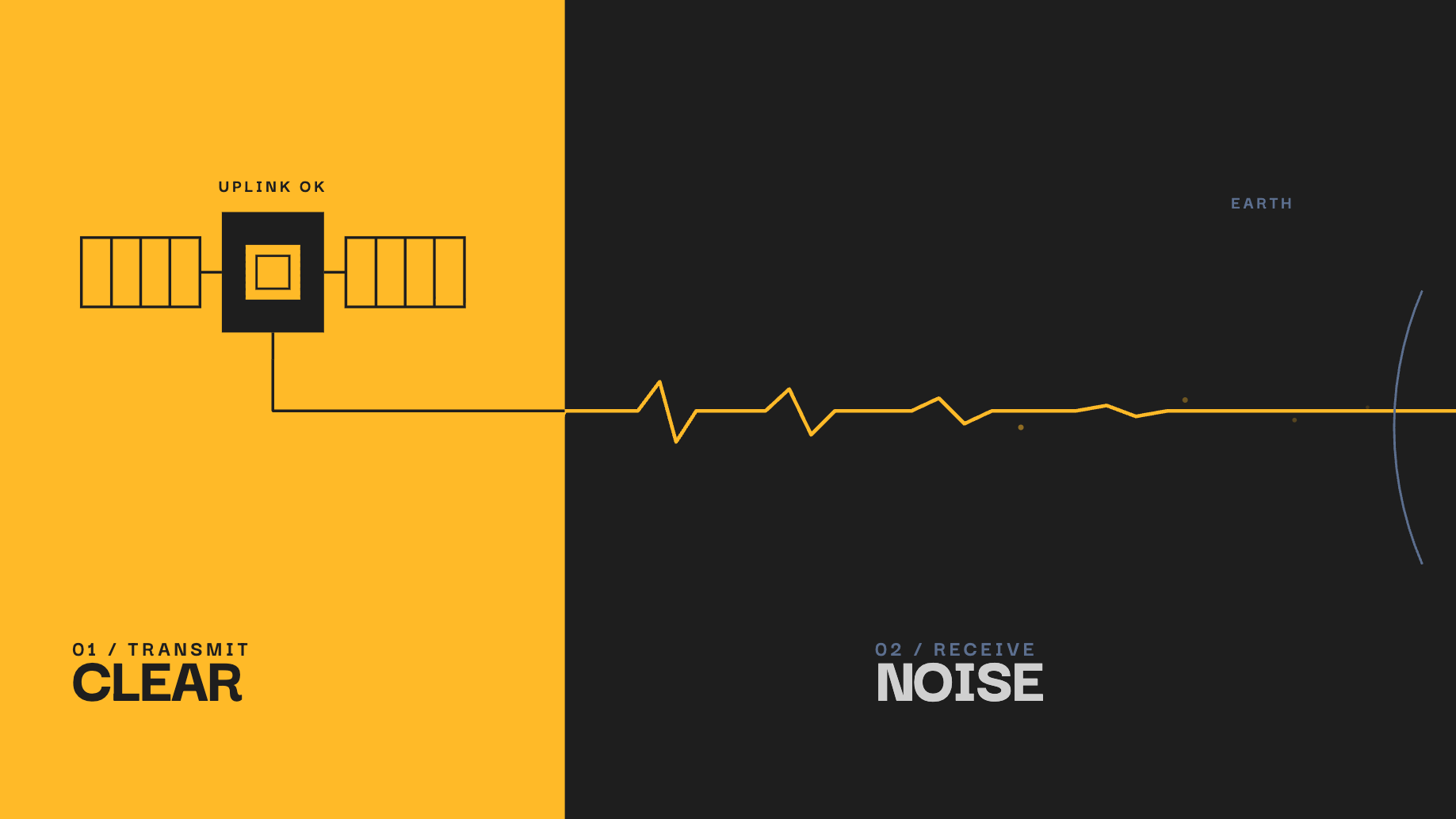
I spent a day at a deep tech summit recently talking to founders across the funding spectrum, from freshly minted Series A companies to businesses that have been shipping for over a decade. Each was at a different stage, in different markets, with different technologies. But one problem kept surfacing, almost word for word, across five separate conversations.
None of them could tell me what their company was worth.
They could all tell me what it was, in precise, fluent, technically correct detail. But when I asked the simple question every investor and every customer is really asking, "what does it do for me," the answer kept coming back as a spec sheet.
Here is the clearest example, with the company kept anonymous because the founder was incredibly smart, generous with their time, and building something important. Which is rather the point.
We got talking. I asked what the company did. Without a word, he reached into his pocket, produced some hardware, and walked me through its technical specifications. I asked again: what does it do? He answered by telling me, in detail, what the componentry does. Not what it changes. Not what it protects. Not what it is worth to the person holding it.
That evening I went to the website. It added a second layer of fog. Clean enough, but it read like a parts catalogue, somewhere between a Screwfix listing and an Amazon product page. Nothing on it told me what the thing was for.
So I dug. And here is what that company actually has. The product is an entropy source: the component that generates the raw randomness sitting underneath encryption. That still sounds dry until you follow the thread. Every encryption key depends on randomness. If the randomness is predictable, the key is guessable, and it does not matter how advanced the algorithm sitting on top of it is. This is the quiet foundation that the whole of digital security rests on. Most systems today produce that randomness in software, using deterministic maths to imitate chance. It holds until someone with enough compute and enough motivation decides to work backwards.
Asking a piece of deterministic software to produce true unpredictability is a bit like asking a calculator to write poetry. It can approximate the shape. It cannot do the thing.
This company's board draws its randomness from physics itself, which is about as close to truly unpredictable as it gets.
Now add the timing. Adversaries are already recording and storing encrypted data they cannot yet read. The bet is simple: capture it now, decrypt it later, once quantum machines can break today's encryption. It is called harvest now, decrypt later, and the harvesting is happening today while the decryption waits in the near future. Warehouses of hoarded data are sitting quietly, waiting for the day the locks stop working. Post-quantum cryptography regulation is arriving to force the migration, with 2030 already marked on the calendar as a line in the sand.
So this is the foundational security layer for the post-quantum age, built on elemental physics, aimed squarely at nation-state adversaries and the kind of threats that keep governments and enterprises awake. And the proof was all there. Patented. Tested in low Earth orbit and proven in zero gravity, which is a decent hint it can cope inside a data centre. Trusted by four major OEMs. Cheap. A clear path from a USB key you can hold in your hand up to rack-scale deployment. A regulatory tailwind, and an investor story that stood up. All of it real, none of it landing, while I was being handed a board and a list of specs.
The distance between what that company is and how it was described was enormous. And it was not a one-off. It was the fifth version of the same conversation I had that day.
This bit is key- This is not a criticism of founders. It is the norm among brilliant technical people, and there is a good reason for it. When you have spent years inside a technology, you understand it at the level of how it works. The value it creates for someone standing outside it is a different language, and fluency in one does not hand you fluency in the other. The founder was not failing to communicate. They were communicating the wrong layer, because the technical layer is the one they’ve lived through 50-hour weeks for years.
The cost of that gap is heavy and mostly invisible. In a room full of people who cannot easily tell a real breakthrough from a forgettable one, the companies that win attention are not the best ones. They are the ones that are easiest to understand. Investors nod politely and move on. Customers file it under "not sure I need that." Partners never make the call. The technology does not fail in the lab. It fails to get out of it.
This is the problem we built Latent to solve, and it is why we describe ourselves as the translation layer. Deep tech companies are often technically extraordinary and commercially invisible at the same time, and the distance between those two states is not more engineering. It is positioning, narrative, and the discipline of leading with value instead of specification.
The work has a natural order to it. First you make the technology legible: you find the one sentence that tells a stranger why it matters, before anyone else defines the company for them. That is what turns a board in a pocket into "the foundational security layer for the post-quantum world." Then you build the credibility around it, the proof and the presence that make serious buyers take it seriously. Then, and only then, you turn that into pipeline and revenue. Lab, to market, to commercial traction. Most deep tech companies are stuck at that first step, and most do not realise it is where they are stuck.
We spent years at Arm doing exactly this for compute categories that people could not yet explain. AI silicon, compute subsystems, inference at the edge. None of them sold themselves. The job was turning opaque propositions into language that investors, OEMs and enterprise buyers acted on. The companies I met at that summit need the same thing- Some of them get it, and we’re meeting again this week.
The technology in that room was ready for space. It simply was not ready to be understood. And in this market, being understood is the part that decides whether you make it to revenue.
If you are building something remarkable and watching people not quite get it, that gap is fixable, and it is usually the highest-return work you are not yet doing. The best technology does not always win. The clearest usually does.
I’m Dale, I’m a Co-Founder here at Latent, and I love these kinds of conversations.
The legacy vendor AI repositioning problem
There is a particular kind of pressure that doesn't get talked about in deep tech marketing conversations, because the companies feeling it most acutely are the ones least likely to admit it publicly.
They've been in market for twenty, thirty years. They have real customers, real revenue, and a reputation earned the hard way across generations of product cycles. And somewhere in the last two years, the conversation shifted. The buyers they've been selling to are now asking a different set of questions. The competitors they've spent years outmaneuvering have repositioned as AI companies. The analysts who used to write about them in predictable ways are starting to frame the category differently.

The problem isn't that these companies don't have an AI story. Most of them do. But like everyone else who stamped AI on their product, it sounds like everyone else's.
There's a version of AI repositioning that almost every legacy vendor defaults to. They take the existing product description, add the words 'AI-powered' or 'AI-enabled', update the website headline, and brief the PR team to find an AI angle for the next product launch. It ticks the box. It does not move the market. I’ll admit I’ve been asked ‘Can you make this more AI-washed?’ and the best answer in my experience tends to be ‘no’.
The reason it doesn't work is that technically sophisticated buyers; the CTOs and architects and procurement leads at the OEMs and hyperscalers and enterprise customers that these companies are trying to reach have seen this exact skulduggery from fifteen different vendors in the past eighteen months. They know what it looks like, they have a filter for it and when your repositioning looks like wallpaper, you don't just fail to gain credibility — you actively lose it, because the attempt signals that you don't have a story worth telling.
What Arm went through is a useful reference point. The business had built its position over three decades on a clear, defensible model: IP licensing to chip designers who built the hardware that everyone else then built on top of. That model was well understood. The relationships built around it were real and deep. And then the AI infrastructure buildout created a moment where the architecture question — what compute is the world's most demanding AI workloads going to run on — was genuinely up for grabs.
The challenge wasn't technical. Arm's position in AI infrastructure was already strong. NVIDIA runs on Arm. AWS, Google, Microsoft, and Meta were all building custom silicon on Arm Neoverse. The trajectory was there, but the challenge was commercial: how do you reposition as a company at the center of the AI infrastructure story without disrupting the licensing relationships that built the business, and without making claims that your ecosystem of partners will immediately fact-check and find wanting?
The answer wasn't a campaign. The proof points that were specific, verifiable and credible to a technical audience. The broader narrative came second, built around those proof points rather than built in advance of them. And the message was calibrated differently for each audience: for the investor, the story was about where AI compute was concentrating and why Arm's architecture was structurally advantaged; for the OEM and the chip designer, the story was about what specifically had changed in the tools, the ecosystem, and the programme support available to them.
That sequencing, with proof before narrative, and different narrative for each seat is what most legacy vendor AI repositioning gets wrong. The instinct is to announce the position before the proof is assembled, because the competitive pressure feels urgent and the board wants to see something in market. The result is a claim without substance reaching the exact audience most skilled at identifying claims without substance.
The other failure mode is narrowing too early. Legacy vendors often try to claim AI relevance in the specific product category they already occupy, because that's the safest ground. What they miss is that the more interesting and defensible AI story is often structural — about where they sit in the supply chain, what they enable that nothing else can, and why the AI transition makes that position more valuable rather than less. That's a harder argument to make, but it's the one that lands with the buyers and investors who are trying to understand what the next five years look like.
The companies getting this right are the ones who've accepted that AI repositioning is not a marketing exercise. It's a commercial strategy question that marketing then has to express. The sequence is: understand where you actually sit in the AI value chain, build the proof that substantiates that position, then build the narrative. In that order. Reversed, it produces exactly the kind of repositioning the market has learned to ignore.
Dale Kaszycki is a Co-Founder of Latent