
Selling RISC-V into safety-critical markets: trust is built on the evidence you publish
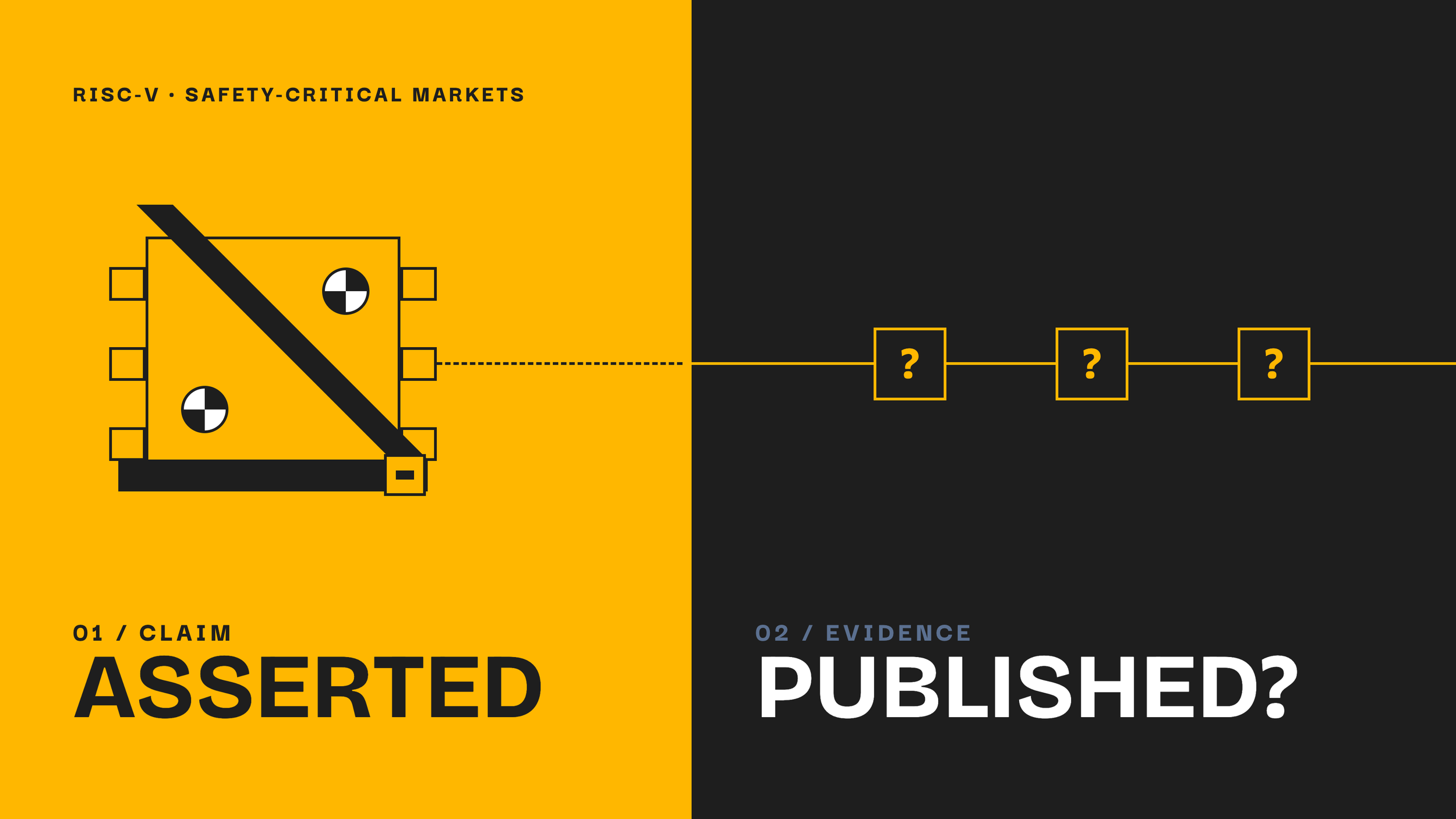
In automotive, aerospace and defence, buyers check your evidence before they agree to a call. At the RISC-V panel at Microelectronics 2026, chaired by Andy Moore of RISC-V International, Markus Willems of MIPS and John Ronco of SiFive described what that evidence looks like: certified cores, a safety process that starts on day one, and named customers such as Infineon and Microchip.
Most of that evidence never reaches a RISC-V company's website. It sits in certificates, NDAs and the heads of the sales team. My first blog from the panel looked at why buyers still ask whether RISC-V is ready. This one is for anyone selling RISC-V into regulated markets, where the buyer's own research decides who makes the shortlist.
"Is RISC-V open source?" Your buyers may think so
John Ronco raised a misconception he hears often: because RISC-V is an open standard, people assume RISC-V processors are open source. Some are. Most cores that go into safety critical products are licensed from a company, and in Ronco's words, many customers "want to buy from a trusted party". He said safety is a big part of that market, because those buyers want high quality processors with a supplier who stands behind them.
To a safety buyer, "open source" can sound like nobody is responsible when something goes wrong. If your website leans on the word "open" and says little about support, some buyers will take that reading away with them, and they won't ask you to correct it.
What to do: answer "Is your product open source?" in your FAQ, in two or three sentences. Say what is open (the instruction set), what you license, who supports it and for how long.
Safety is a process. Show buyers yours
Markus Willems was clear that safety can't be bolted on at the end. "You really need to think safety from day one, from a documentation perspective, from a verification perspective." The features come on top of that process: dual-core lockstep, where two cores run the same code and check each other's results; memory protection; safety mechanisms you can configure to the level the application needs; and software test libraries. He added that safety depends as much on system knowledge as on the core itself.
A functional safety lead wants to know how you got to the certificate. How were requirements traced? How was the core verified? What documentation ships with it? Many vendor safety pages show a certificate logo and a feature list, and leave the buyer to ask for everything else.
What to do: write a safety page that walks through your process in order: how you capture requirements, how you verify, what documentation you supply (safety manual, failure analysis reports) and which safety levels each core supports. Explain lockstep and ASIL (the automotive safety integrity levels, A to D) in a line each, for readers outside the safety team.
Give every certification a permanent page
Safety covers what happens when hardware fails. Cybersecurity covers what happens when someone attacks it, and automotive buyers now ask about both. Ronco and Willems both brought up ISO/SAE 21434, the automotive cybersecurity standard. SiFive and MIPS have each certified processor IP to it, within days of each other .
Most vendors announce a certification in a press release, and the release slides down the news page. When a buyer later searches for an ISO/SAE 21434 certified RISC-V core, or asks ChatGPT the same question, they find a dated announcement or a competitor's product page.
What to do: publish one page listing each standard you hold, with what it covers in plain words, which products it applies to, the date and who certified you. Link to it from every product page and from your sales decks.
Name your customers, with their permission
The panel named two programmes. Willems said Infineon's architecture for automotive control is based on RISC-V, with MIPS supplying the cores and bringing the safety experience it built on its earlier proprietary architecture. Ronco said Microchip's next-generation space microprocessor, with safety and robustness features built in, is built around SiFive cores and is going into several US programmes.
An automotive buyer who sees Infineon's name knows that a company with the same safety requirements has already done the due diligence on that core. Getting permission to name a customer usually starts with the account owner, well before marketing writes anything.
What to do: ask your top three customers for one public step each: a joint announcement, a quote you can use, or a shared conference talk. Give each one that agrees a page of its own.
Defence buyers are asking for RISC-V. Can they find you?
Willems said much of the aerospace and defence work MIPS sees is confidential. What he could say is that some requests for information (RFIs) now require RISC-V, partly for geopolitical reasons. These programmes bring many design starts at low volumes, and he called that a tremendous opportunity.
Defence buyers tend to research and shortlist before they contact a supplier. They want to know where your IP was developed, how your supply chain works and how long you will support a product. If your website doesn't cover those points, you may never learn you were considered.
What to do: publish an aerospace and defence page covering where your IP comes from, your supply chain, your support commitments and who to contact. Keep it factual, because the buyer will check every line.
Safety plus AI: the message few vendors have written
Ronco recalled a talk Infineon gave at a RISC-V summit. Its automotive microcontrollers have always needed real-time control, and now they also need "a bit of AI". RISC-V lets Infineon add the capabilities each job needs to a common core. Willems said physical AI, from sensing to robots, is a growing focus for MIPS, helped by GlobalFoundries' sensor business.
Safety buyers will ask how you add AI without weakening the safety case. An AI feature changes what the system does, so an assessor will want to know how it is kept apart from safety functions, how it is verified and how it is documented. Few RISC-V vendors answer that on their websites yet.
What to do: add a short section to your safety page on where AI features sit in your safety case: which safety levels they support, how they are separated from safety functions and what your verification covers.
Where to start
Everything the panel described is evidence a safety buyer looks for: an accountable supplier, a documented process, certifications, named customers and a plan for AI. Most RISC-V companies already hold some of it. Put it on your website in plain language, and buyers find it while they research, before they ever speak to your sales team.
If you want to see what those buyers find today, we run a free Signal Check focused on trust signals: your certifications, references and safety content, scored for search and AI answer engines, with the fixes ranked by impact.
I’m Dale Kaszycki- Co-Founder of Latent, a B2B marketing consultancy for deep tech. I help companies build brands and revenue pipelines that get specified by AI-tools.