
Will AI replace your MarTech Stack?
Some of it already can. Here’s how to tell which tools are real products and which are features an LLM can absorb.
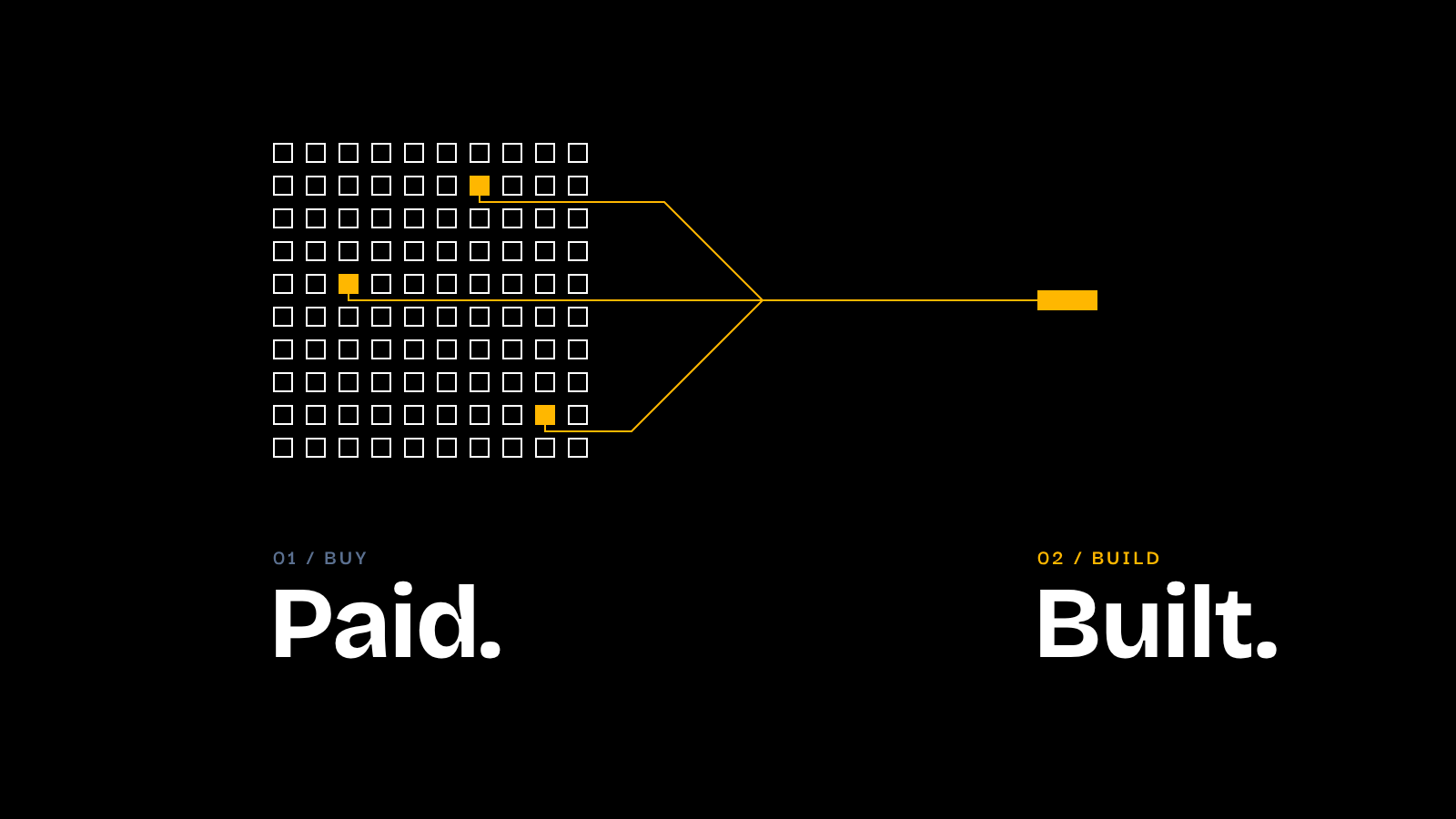
Grid of 100 hollow squares with three in amber, joined into one bar, labelled “Paid.” and “Built.”
Do you remember Peach?
It was a social network app that, for a brief few weeks a decade or so ago, was going to be the new Facebook.
Hot new social apps blew up and died, or got acquired and killed, quite a lot. Most of them deserved to die. They were too easy to copy before network effects could take hold.
Right now, AI in MarTech feels eerily similar to me.
Why are there so many MarTech tools?
Since starting Latent, I have been pitched half a dozen AI CRMs and at least a dozen AEO tools. I've lost count of how many sentences start "we're the AI-native version of..."
This is on top of established software platforms rushing to the party with their own AI features (usually on the next pricing tier up), or their MCPs letting you bring your own LLM.
And then there's the LLM platforms themselves, whether it's GPT, Claude, Muse, Copilot, or Gemini... There's a new capability and a new model being released almost every week. With everyone already concentrated on these platforms, they’re not just essential tools, they have become the new networks.
Is your software a product or a feature?
What feels all too familiar to the early social days, is that companies are launching products which can be made into features by the networks (Claude/ChatGPT). Think Instagram copying Snapchat.
A real example: I don't have to upgrade my CRM because I can build workflow automation with Claude and read/write to fields using my CRM's API or MCP.
The legacy CRM wants to sell workflow automation as a product, the new "AI native CRM" is using AI built into their platform to do it. But it's just a feature, I've already built it and moved on.
Whatever your task, there are a dozen tools all trying to lock you into 2 year contracts with 5-10% price increases on renewal. And most of us are paying for a premium tier with 100 features because 3 of them are essential while the other 97 are irrelevant.
Why the SaaSpocalypse will be slower than expected
For big enterprises, the trade off is harder. They have IT, Legal, Ops, Procurement, Finance... who all have processes, standards, annual budget reviews. You have to think about risk mitigation, maintenance, scalability. When shit hits the fan, it needs to have left an audit trail.
Without a broader organizational change, continuing to pay for the dedicated tool will often be the easy route, even though you can replace it using the AI platform the enterprise is already paying for. I think this is one of the biggest reasons "SaaSpocalypse" will be slower and less evenly distributed than first thought. Ask people who work in digital transformation and they will tell you change is slow if it ever even happens at all.
But for startups and smaller companies, the opportunity to build your software stack, processes and teams as AI-first is huge. With the right knowledge, access to a model and time, you can build a stack which operates with the functionality of a stack 100x the cost.
How should you audit your MarTech Stack?
I'd start with why you think you need the software in the first place. What is the repeated task or outcome you need to automate? Does that outcome really need software to be achieved? I have been surprised how often the answer to that question is "not anymore".
If evaluating an existing stack, ask:
"What is a feature, not a product?"
(An easy tell: is it just a UI on top of an API call?)
If it is, it's worth thinking seriously about how you could re-build and manage the workflow. Think setup, maintenance, auditing, scaling, hosting.
While you won't replace your CRM overnight, what about your orchestration tool, or BI tool, or social management tool, or URL shortener, or SEO/AEO platform, or competitive insight tool, or data enrichment platform, or intent platform, or personalization tool...
It might sound unrealistic or not worth the bother, but just this month I have built my own UTM builder, multiple orchestration workflows, an AEO tool, and a reporting tool. Costing all of that up, it's just shy of $19,000 a year equivalent of SaaS platform costs.
If I can save a few tens of thousands of dollars, so can a whole lot of other folks.
Where's the money going to go? Right now, it looks like it will go to the same place it went to with social media... the big platforms. What will happen to undifferentiated 'AI native' platforms? they'll probably end up like Peach. Eaten.
Simon Jared is Co-Founder of Latent, a B2B marketing consultancy for deep tech. He helps companies build AI-first marketing operations.
Book a call.